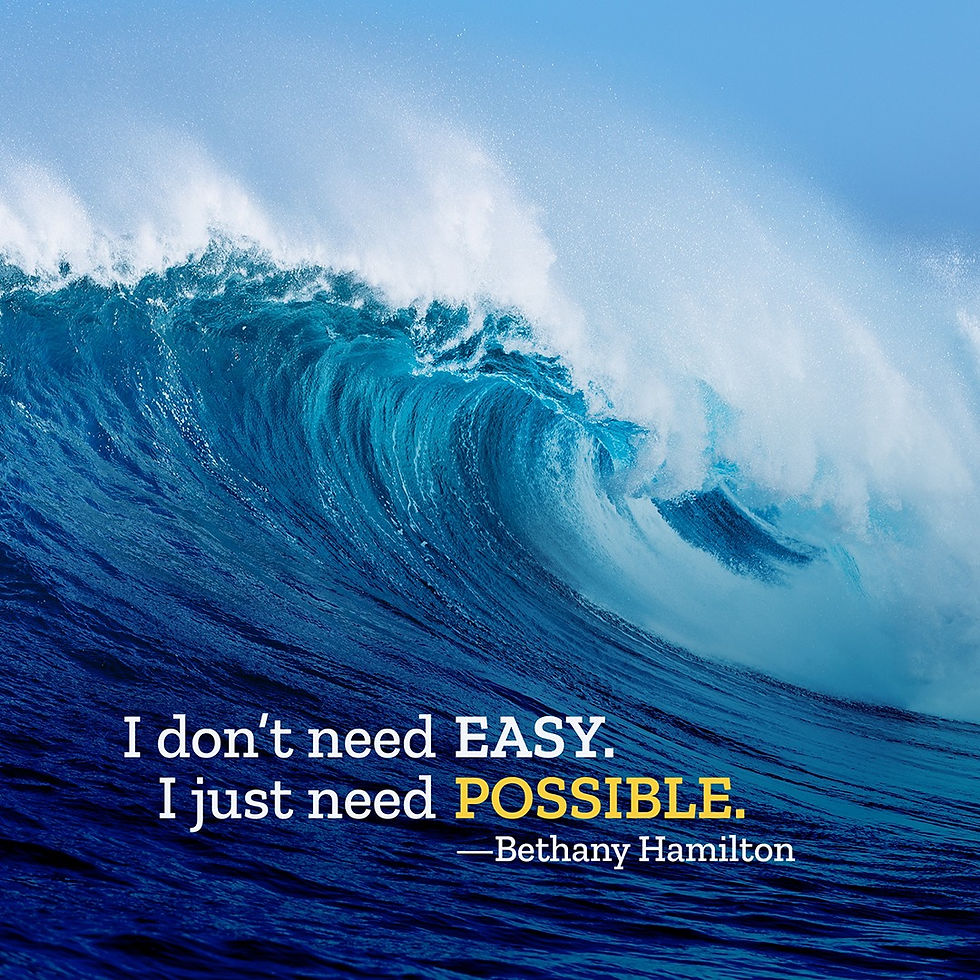
"I don't need easy, I just need possible"
- britneysoll2
- Aug 15, 2025
- 4 min read


Hamilton's words resonate in my core and bring tears to the back of my eyes.
The relationship between "easy" "possible" and "uncertainty" has been pivotal in my life. I am of the view that it is pivotal in just about anyone's life.
When we go through distressing and painful events, whether large or small, sudden or chronic, we can become stuck. They can colour our worldview, and our outlooks become narrowed by the beliefs that we hold about others, ourselves, and the world. The world can feel like a dangerous place, it can indeed feel safer to go about life with the view and the lens that people and the world are out to hurt or judge us. Now, that is not a fun or easy to be. It is, in fact, quite a miserable way to be.
However, in many ways, the misery becomes familiar company and the certainty of the familiar is easier to tolerate than the "hard" of being open to possibility and letting the hurt and beliefs go.
The issue of labelling ourselves with diagnoses is that we can come to carry the feeling of being ineffectual in the world. Victims of circumstances and people. You feel at the mercy of the happenings of the world, and all you can do is sit back and wait.
I've lived on both sides of the diagnostic labels, and the problem with diagnoses, as I lived them, and as I've seen many people live them, is that you cling to the certainty of the diagnosis, of the explanation and reasons that it provides for your way of going about living. They removed the weight and responsibility of how I was complicit in my situation and my misery. This circumstance only served to confuse my sense of self and increase my suffering.
In 2019, my diagnoses were PTSD, severe anxiety, and severe depression. These diagnoses became reasons to not. They became reasons to not make new friends, reasons to not see the good, reasons to not self-reflect on how I was perpetuating my own anxiety and depression. They became reasons to not trust. They were reasons to not even see or believe in other possible versions of me. Me's who could perhaps enjoy the process of living.
The turning point came in a very ordinary moment when I was driving out of the village where I'd been volunteering. A sharp rap on my door made me jolt and my blood pounded in my throat. That terrible, familiar hypervigilance that governed my life, that I was a "victim" of. A man stood there, and gestured to tell me that my car door was not well closed. The tightness migrated to behind my eyes and I wept because it hit me: I was the only person who was keeping me miserable. My mind. And I was heavy, and tired of my own unhappiness.
It is hard to choose possibility when the world has hurt you, it's hard to see the good, and much easier (albeit miserable) to stay tucked away in the safety of assuming the worst.
This realization did not fix me, but it started me down the road of reorienting my life.
Two major changes had to occur.
First, radical responsibility.
I learned through my work with children, dogs, and horses that you cannot force anyone or anything else to change, but you can change yourself, and in changing yourself, your behaviour, you then influence what happens around you. The new responses, in turn, impact your mind in a new way.
In everything, I tried to make it less about how I needed others to change or behave. This simply wasn't workable. I also stopped expecting things from life, good or bad. I started appreciating what works, savouring the small moments and processes - the dark green on the mountain and the light bouncing off the sugar cane on the backdrop of the sea. A good apple. Small glances. I started living with a sense of wonder - a sense that was familiar from childhood.
Jordan Peterson has a great quote: "Good people aren't naive, they're tough as they can possibly be, and they've seen things." This quote resonates with me, because choosing to live in wonder is not naive, nor does it come naturally. It is a conscious choice. It is an intentionally developed and practiced habit.
To me, it has taken enormous work to learn to hold the ambiguity that there is good and evil, and still choose to concentrate on what is good. To act on the life I want to live, and not on momentary anxiety.
Second, courage.
The courage to feel sadness and anger, but also contentment and happiness. The courage to do the scary or the hard thing to move my life in the direction I want it to go. To constantly show up for the life I want.
There is a misconception that choices are easy. But I'm choosing my hard, because I've lived the other hard. The hard that comes as a consequence of doing the "easy" thing and choosing certainty. I've lived that kind of hard, and it's not for me. I choose the hard of being open to possibilities, to potentialities, to uncertainty, to people, and to all the ways my life COULD go.
I don't need the easy, I don't need the certainty. I choose the possible.


Comments